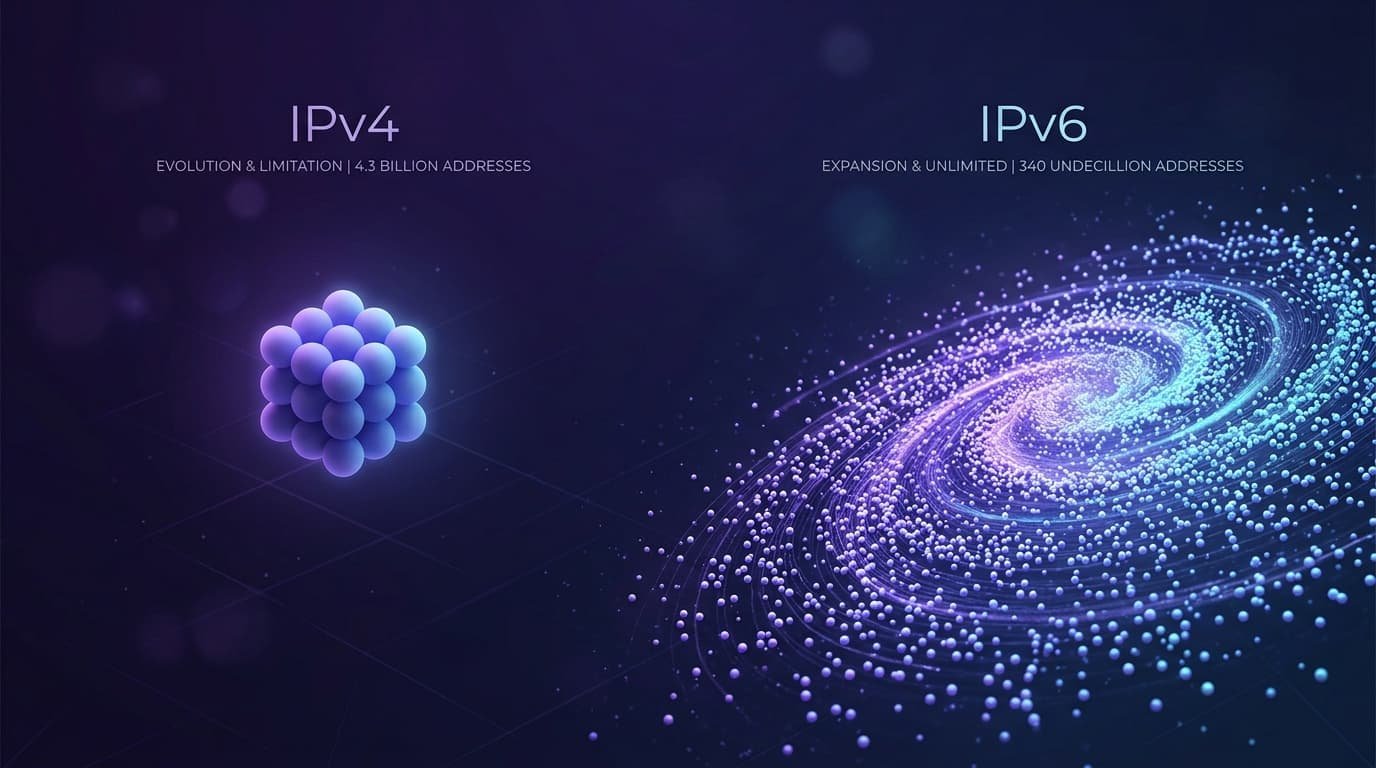
Imagine the Internet is a huge city that never stops growing. At first, all houses had simple numbers (IPv4), but there came a time when numbers ran out for so many new houses. To solve this, a much more extensive and modern address system was invented: IPv6.
1. IPv4: The lifelong standard
IPv4 has been used since the 80s. Its format consists of four groups of numbers separated by dots (e.g., 192.168.1.1). The problem is that it only allows about 4.3 billion addresses, which have already run out due to the number of devices connected today.
2. IPv6: The infinite future
IPv6 was born so that the internet would not collapse. Its format uses eight groups of hexadecimal characters. It allows for 340 undecillion addresses; basically, we could assign an IP address to every grain of sand on the planet and still have plenty left.
3. Key differences
- Security: IPv6 was designed with built-in encryption (IPSec).
- Speed: It is more efficient in handling data packets by routers.
- Goodbye NAT: With so many addresses, it is no longer necessary to 'hide' devices under a single public IP, as explained in our article on public and private IP.
| Feature | IPv4 | IPv6 |
|---|---|---|
| Format | 32 bits (Numeric) | 128 bits (Alphanumeric) |
| Security | Optional | Integrated (IPSec) |
| Configuration | Manual / DHCP | Auto-configuration |
Is your current connection using IPv4 or IPv6? Check it right now.
Check my IP typeDoes your current connection seem insecure? Learn how to change your IP address step by step to improve your privacy.